
TL;DR
- An event highlights film loses value every day it isn't out. People forget the room, and a film that arrives after the feeling has gone is just footage of an event.
- Extra days of editing buy less than you'd think. The first days do most of the work; after that, the audience can't tell an 80 from a 90, while the film keeps getting older.
- Accuracy is the one thing speed never gets to win. Names, job titles, logos and what a speaker actually said have to be right, on day one and on day thirty.
- When you compare quotes, ask four things: when the first cut arrives, how many rounds of changes, when the final version arrives, and who on your side reviews the first cut.
The applause ends, the hall empties, and for a day or two everyone who was there still has the room in their head. The moment the product was unveiled. The line from the keynote people repeated over dinner. Who was sitting at which table.
That window is what an event highlights film is made for. Sent while it's open, the film lands on people who remember, and they fill in the rest themselves. Sent three weeks later, it lands on people who have moved on to the next thing.
So on event films we hold an opinion that sounds odd coming from a studio: we would rather be fast than perfect. Here is why, and the one place where speed is never allowed to win.
How fast should an event highlights film be delivered?
As soon as it can be without getting anything wrong.
Our standard is a first cut within three days of the event. It's the timeline on our corporate event video page, and the reason given there is the same one this page is about: an event film is worth most while people still remember the room.
If it were only up to the calendar, sooner would be better still: the day after, or the day after that.
Why does an event film lose its value so quickly?
Because its first audience is the people who were there, and the film plays against their memory of the day.
A highlights film works by bringing the room back. You see the stage you sat in front of, you recognise the people at the next table, you hear the line you were already quoting. While the memory is fresh, a few minutes of film is enough to put the viewer back in the hall. Once it fades, the same film has to do all that work on its own, and it can't. People forget what was said. More than that, they stop being able to feel what the room felt like.
The people who weren't there run on the same clock. The day after an event, it's still something everyone in the company is talking about. A month later, it's last month.
What makes an event film valuable, and how does that change over time?
We think of it as three things, and they behave very differently as the days pass.
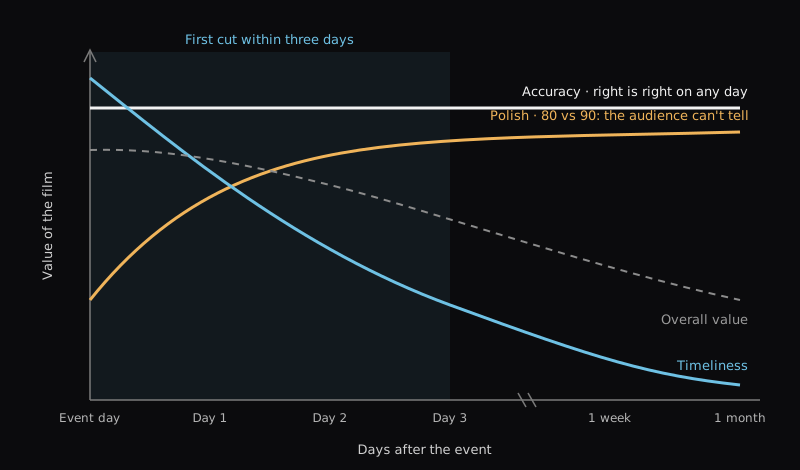
How we think about an event film's value over time. A sketch of our judgement, not a measurement: timeliness falls fast, accuracy doesn't move, and polish rises and then flattens out.
- Timeliness falls fast. It's highest on the day of the event and drops quickly over the next few days, for the reasons above. Nothing you do in the edit brings it back.
- Accuracy is a flat line. A name spelt correctly is correct on day one and on day thirty. It doesn't gain value by waiting, and it doesn't lose any either.
- Polish rises, then flattens. It starts a little low, climbs quickly over the first days of editing, and then levels off. Past that bend, each extra day buys very little.
Put the three together and the shape is clear: the later the film arrives, the more of its value is gone, and the extra polish doesn't make up the difference.
That chart is a sketch of how we think about it, not a measurement. There are no numbers on the vertical axis because we haven't measured any, and we'd rather not pretend to.
Why not take a few more days to make it better?
Because the days that make the biggest difference are the first ones.
Most of what makes an event film good happens early in the edit: choosing the moments worth keeping, finding the order that tells the story of the day, getting the length right. That's the steep part of the polish line. After it, the work is refinement, and refinement is where the curve goes flat.
An audience can tell a rough film from a good one. It can't tell an 80 from a 90. The difference between the two might be several more days in the edit, and nobody watching would see it, while the timeliness line has kept falling all that time. On an event film, those days cost more than they add.
None of this is an argument for careless work. It's an argument for spending the effort where it shows. Our video production timeline says the same about quick jobs in general: trim the finish to what the piece actually needs.
What should never be traded for speed?
Accuracy.
The names on screen, and how they're spelt. Job titles. Company and sponsor logos. What a speaker actually said, not a paraphrase of it. These are the flat line on the chart, and they're the reason "fast" can't mean "careless". A first cut that arrives in two days with the chairman's name misspelt has gone backwards, and a mistake like that doesn't fade with time either. It travels with every share.
So we ask for the facts before the event rather than after it: the run sheet, the speaker list with names and titles exactly as they should appear, and the logo files. If those are settled on the day of the event, nobody is chasing them while the clock runs.
How do you compare turnaround times between quotes?
Quotes for the same event can promise very different turnarounds, and the headline number on its own doesn't tell you much. Ask four things:
- When does the first cut arrive? Counted from the end of the event.
- How many rounds of changes are included, and how long does each take?
- When does the final version arrive? This is the one you'll actually share.
- Who on your side reviews the first cut, and how fast can they reply?
The fourth question is the one people skip, and it can matter as much as the studio's speed. A first cut that arrives in three days and then waits a week for internal comments has lost the week anyway. One consolidated round of notes, gathered from everyone who has a say before it's sent, is the fastest way through. We've written more about that in revisions and approvals.
When is it right to take longer?
When the film has a second job that has nothing to do with the moment. Some event footage is really meant for next year's invitation, the website or a sales presentation. That film will be judged months from now, by people who weren't in the room, so timeliness hardly matters to it and polish does.
We don't make one film carry both jobs. The highlights still go out within three days, while people remember the room. The longer-life film is cut separately, from the same footage, on its own schedule.
What this page can't tell you
It can't tell you how quickly your own audience forgets. The curve above is our judgement from making event films, not a study, and some events stay in people's heads longer than others.
If you have an event coming up, start with our corporate event video page, and there's a selection of event films we've made on Vimeo. Bring the date, what the film needs to do afterwards, and the name of the person on your side who will check the first cut.
Thinking about a project like this?
Tell us what it needs to do — we'll take it from there.
Frequently asked questions
- How long does it take to deliver an event highlights film?
- It varies a lot between studios, from a couple of days to several weeks. With us, the first cut arrives within three days of the event. We cut for speed first and polish second, because an event film is worth most while the people who were there still remember the room.
- Is a fast event video lower quality?
- Not where it counts. The first days of editing do most of the work: choosing the moments, building the structure, cutting to length. Extra days after that buy refinements most viewers can't see, while the film gets older. The one thing that is never traded for speed is accuracy: names, titles, logos and quotes have to be right.
- What should I ask a studio about turnaround time for an event video?
- Ask when the first cut arrives, how many rounds of changes are included, when the final version arrives, and who on your side will review the first cut. The last one matters as much as the studio's speed: a first cut that waits a week for internal comments has lost the week anyway.
Keep reading
- What Should a Site Safety Induction Video Show, and Who Should Be in It?A site induction video plays to strangers at your gate every day. What it has to show from your own site, who should be on camera, how to handle languages, how to keep it current when the rules change, and when a notice and a short briefing are enough.
- Should Your Explainer Video Be Animated, Filmed, or Made With an AI Presenter?Before the script and before the quotes, an explainer needs one decision: what it's made of. What animation, live action and an AI presenter are each good at, how they handle English, BM and Chinese versions, which is cheapest to update, and when we'd tell you not to film at all.
- Training Videos for Your Staff: Film Them, Use an AI Presenter, or Screen-Record?Before you decide who makes your onboarding, induction or SOP videos, decide how often they'll have to change. What a proper shoot is worth spending on, where an AI presenter does the job, when a screen recording is the whole answer, and how to mix the three.